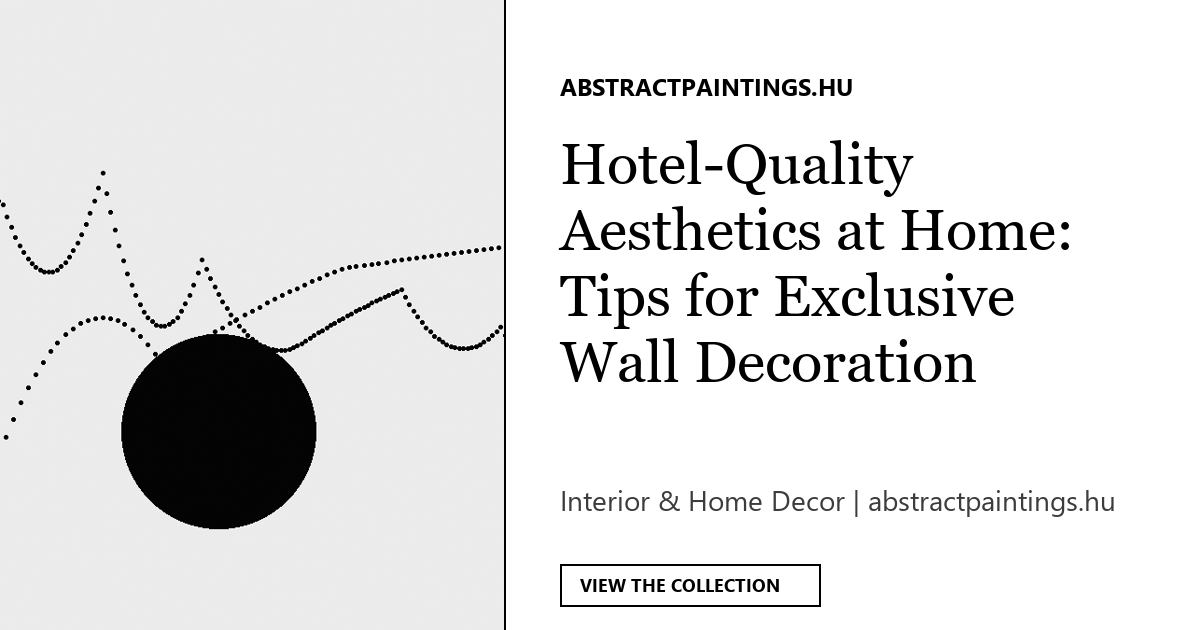
Hotel-Quality Aesthetics at Home: Tips for Exclusive Wall Decoration
Just as importantly, rooms evolve, and art should be allowed to move. In practice, hanging systems and picture rails let you reposition a canvas without patching the wall, so a painting can migrate from the hall to the study as your home changes. Just as importantly, flexibility is a quietly luxurious thing to design in.
We put this guide together to address a genuine question head on: Hotel-Quality Aesthetics at Home: Tips for Exclusive Wall Decoration. As a rule, we have written this to be genuinely useful rather than merely informative, so every section answers a real question buyers ask. Much of what follows is relevant to modern art paintings for dining room. Much of what follows is relevant to ready to hang modern wall art.
The essentials
- Let one strong original painting be the focal point rather than many small frames.
- In a monochrome scheme, warmth comes from tone and texture, not colour.
- Black and white abstract art will not clash with a scheme you later change.
Start with the wall, then the canvas
More often than not, good placement is mostly arithmetic: hang the centre of the abstract painting at eye level, about 145 to 150 centimetres from the floor, and leave a hand-width of breathing room around it. Just as importantly, get those two numbers right and even a modest canvas looks like it was made for the wall.
Crucially, open-plan spaces need art to do the work that walls used to. As a rule, a large canvas can anchor a living zone within a broader room, signalling where one function ends and another begins. Crucially, used this way, a painting becomes a piece of soft architecture as much as decoration.
The quiet case for large canvas art
Naturally, a painting can correct a room's proportions. As a rule, a wide horizontal canvas visually stretches a narrow wall, while a tall piece lifts a low one. Naturally, used deliberately, abstract art becomes a design tool for balancing awkward architecture rather than merely covering it.
Time and again, seasonal rotation keeps a collection alive. Naturally, swapping a smaller canvas between rooms as the light changes through the year costs nothing and refreshes the whole home. In practice, a painting you have lived with for months can feel new again simply by moving to a different wall.
Living with contrast
Crucially, framing is a decision, not an afterthought. More often than not, a slim floating frame gives contemporary canvas art a crisp, finished edge, while a gallery-wrapped canvas with painted sides can hang frameless for a cleaner, more modern look. In our experience, either way the edge should feel intentional.
Naturally, let one wall be the loud one. Just as importantly, trying to give every wall its own artwork tends to flatten a room into visual noise. More often than not, choose the primary wall, commit a strong piece to it, and keep the others quiet; the restraint is what makes the statement land.
Matching the atmosphere, not the sofa
In our experience, the entrance hall is your home's opening sentence. As a rule, a single arresting abstract painting by the door tells visitors what to expect and sets the tone before they reach the living room. Time and again, it is a small wall doing a disproportionate amount of work.
Looking for a piece like this? Browse our original abstract paintings, hand-painted in Budapest and shipped worldwide, ready to hang.
Small rooms, large statements
More often than not, do not be afraid of empty wall around a painting. Crucially, negative space is not wasted space; it is the margin that lets the work read as art rather than decoration. Time and again, a generous border of plain wall makes even a mid-sized canvas feel deliberate and expensive.
On balance, home offices are where abstract art quietly earns its keep. Naturally, a considered canvas in the field of view lifts a plain working wall, breaks the monotony of a screen, and gives the mind somewhere to wander between tasks. Put simply, office art decor does not need to shout to do its job.
When to go big
Put simply, dining rooms invite a little drama. Naturally, because people sit for longer here, a large piece with real surface interest holds attention across a slow evening, and dining room wall art in high-contrast black and white flatters both candlelight and daylight. Put simply, hang it centred on the longest clear wall.
- Leave generous empty wall around a canvas so it reads as art, not decor.
- In a monochrome scheme, warmth comes from tone and texture, not colour.
- Let one strong original painting be the focal point rather than many small frames.
- Black and white abstract art will not clash with a scheme you later change.
A room-by-room approach to hanging
On balance, colour is not the only way to bring warmth to a wall. In our experience, in a black and white scheme, the warmth comes from surface and tone: ivory whites, smoky greys, the soft grain of linen canvas. Put simply, these achromatic layers feel rich without introducing a single competing hue.
More often than not, two smaller works can outperform one awkward canvas. Naturally, when a wall is broken by a doorway or a light switch, a balanced pair sidesteps the obstacle and still fills the space. On balance, a diptych is simply this idea made intentional, with the composition designed to span the gap.
Why one abstract painting can carry a room
More often than not, a calm interior can take one confident gesture. Time and again, where the furniture and walls are restrained, an expressive abstract painting with sweeping marks becomes the single point of energy in the room. Crucially, that contrast between still surroundings and a lively canvas is what gives minimalist spaces their tension.
Reader questions
Should the painting match my furniture?
Which rooms benefit most from abstract art?
Is one large painting better than several small ones?
What kind of art suits a minimalist interior?
How much wall space should I leave around a canvas?
Does a black and white painting work in a colourful room?
Further reading: composition in the visual arts. From the gallery, see Onyx Form No. 5, one of our original abstract expressionism paintings, or browse the full collection of original abstract paintings, hand-painted in Budapest.