How to Choose the Perfect Abstract Painting for Your Living Room
The entrance hall is your home's opening sentence. A single arresting abstract painting by the door tells visitors what to expect and sets the tone before they reach the living room. It is a small wall doing a disproportionate amount of work.
Few decisions in decorating a home come up as regularly as this one: How to Choose the Perfect Abstract Painting for Your Living Room. What follows is a practical, jargon-free look at exactly that, from people who handle original canvas art every day. If your search brought you here from vibrant expressionist canvas painting, you are in the right place. This is a sound starting point for custom colored abstract artwork as well.
Before you read on
- Choose scale first: aim for a canvas that fills about two thirds of the wall.
- Black and white abstract art will not clash with a scheme you later change.
- Hang the centre of the piece around 145 to 150 cm from the floor.
A room-by-room approach to styling
Open-plan spaces need art to do the work that walls used to. A large canvas can anchor a living zone within a broader room, signalling where one function ends and another begins. Used this way, a painting becomes a piece of soft architecture as much as decoration.
Symmetry calms a room; a deliberate break from it energises one. Centring a canvas over a fireplace reads as classic and settled, while hanging it slightly off a natural axis creates a subtle tension the eye enjoys. Both are valid; the choice sets the mood.
Why one abstract painting can carry a room
The wall behind a bed is a chance most bedrooms waste. A single calm canvas there, sized generously and hung low over the headboard, turns a functional room into a restful one. Keep the tone quiet and let the piece be the last thing you notice at night.
Reflective surfaces deserve caution. A high-gloss finish looks spectacular but can bounce a window straight back at the viewer, so in a bright room a matte or satin surface often reads better. Check the glare from where people actually sit before you hang.
Living with monochrome
Good placement is mostly arithmetic: hang the centre of the abstract painting at eye level, about 145 to 150 centimetres from the floor, and leave a hand-width of breathing room around it. Get those two numbers right and even a modest canvas looks like it was made for the wall.
Seasonal rotation keeps a collection alive. Swapping a smaller canvas between rooms as the light changes through the year costs nothing and refreshes the whole home. A painting you have lived with for months can feel new again simply by moving to a different wall.
When to go bold
Let one wall be the loud one. Trying to give every wall its own artwork tends to flatten a room into visual noise. Choose the primary wall, commit a strong piece to it, and keep the others quiet; the restraint is what makes the statement land.
Looking for a piece like this? Browse our original abstract paintings, hand-painted in Budapest and shipped worldwide, ready to hang.
Where depth earns its place
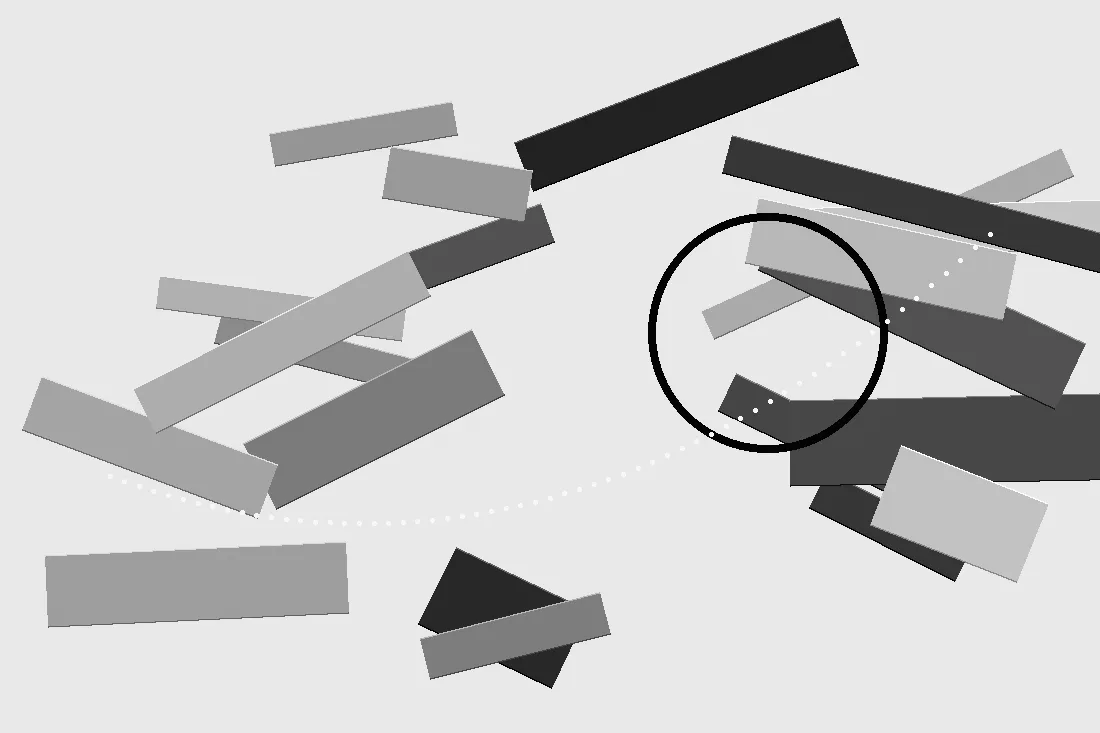
Colour is not the only way to bring warmth to a wall. In a black and white scheme, the warmth comes from surface and tone: ivory whites, smoky greys, the soft grain of linen canvas. These achromatic layers feel rich without introducing a single competing hue.
Texture is what separates a memorable canvas from a flat print. Palette knife ridges and impasto build shadow that shifts as you move past the work, so a heavily worked surface stays interesting for years. In a mostly smooth interior, that tactile quality is a welcome contrast.
Matching the tone, not the sofa
A calm interior can take one confident gesture. Where the furniture and walls are restrained, an expressive abstract painting with sweeping marks becomes the single point of energy in the room. That contrast between still surroundings and a lively canvas is what gives minimalist spaces their tension.
- Leave generous empty wall around a canvas so it reads as art, not decor.
- In a monochrome scheme, warmth comes from tone and texture, not colour.
- Choose scale first: aim for a canvas that fills about two thirds of the wall.
- Match the mood of the artwork to how the room is actually used.
Getting the proportion right
Hallways and staircases are the overlooked heroes of a home. A tall vertical canvas draws the eye upward on a stairwell, while a run of related pieces turns a long corridor into a small private exhibition. These transitional spaces are ideal for modern wall art that you want people to discover slowly.
Think about the piece from the doorway. The first view of a room is usually from its threshold, so position your statement painting where it lands in that opening sightline. A canvas that greets you as you enter shapes the whole impression of the space.
Start with the wall, then the artwork
Rooms evolve, and art should be allowed to move. Hanging systems and picture rails let you reposition a canvas without patching the wall, so a painting can migrate from the hall to the study as your home changes. Flexibility is a quietly luxurious thing to design in.
Questions buyers ask
How big should an abstract painting be above a sofa?
Should the painting match my furniture?
Does a black and white painting work in a colourful room?
Is one large painting better than several small ones?
How much wall space should I leave around a canvas?
At what height should I hang wall art?
Further reading: the minimalist movement. From the gallery, see Alabaster Composition II, one of our original monochrome field paintings, or browse the full collection of original abstract paintings, hand-painted in Budapest.